Ireland has hundreds of whitewater rivers, from gentle Grade 2 runs through rolling farmland to steep Grade 5 creeks dropping out of mountain valleys. Between the reliable rainfall, the mild climate, and the welcoming club scene, it's one of the best places in Europe to pick up the sport.
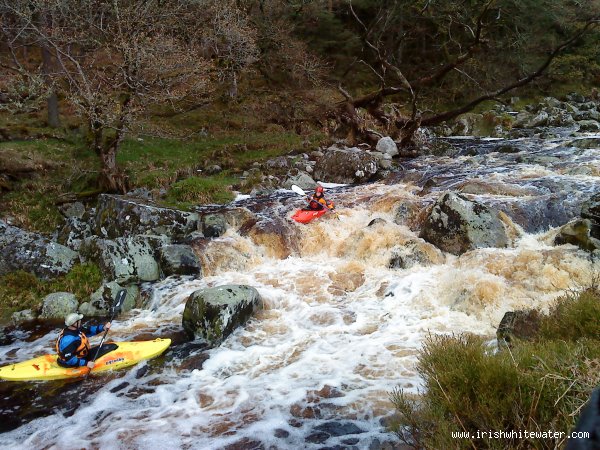
Whitewater kayaking is the sport of paddling a kayak down a river with moving water — anything from a gently flowing stream to full-on rapids with drops, waves, and holes. "Whitewater" refers to the aerated, foaming water created when a river steepens, narrows, or flows over obstacles like rocks and ledges.
It's a different thing altogether from sea kayaking or lake paddling. In a whitewater kayak you sit inside a shorter, more manoeuvrable boat, wearing a spraydeck to keep the water out. The river does most of the work carrying you downstream. Your job is to read the water, pick your line, and use your paddle to steer through the features.
The appeal is hard to explain until you've felt it yourself: the focus required to read moving water, the satisfaction of nailing a line through a rapid, and the fact that every river run is different depending on the water level. It's also one of the best ways to see parts of Ireland that most people never get to experience.
In Ireland, the terms "kayaking" and "canoeing" are often used interchangeably. You'll hear people say they're "going canoeing" when they mean paddling a kayak on whitewater. Technically a canoe is an open boat paddled with a single blade, while a kayak is a closed boat with a double-bladed paddle — but in everyday Irish usage, the two words overlap and both are used to describe the same sport.
Rivers are graded on a scale of 1 to 6 based on technical difficulty. In Ireland and the UK, these are referred to as "grades" rather than "classes" (the American term). Here's what each grade means in practical terms:
Slow-moving water with no significant obstacles. Grand for absolute beginners on their first outing.
Small waves, gentle stoppers, and simple obstacles. The route downstream is obvious. You'll need to be able to steer your boat and have a reliable capsize drill. Plenty of Irish rivers that are great for building skills fall into this category. The Boyne in Meath, the Maigue in Limerick, and the Barrow are good examples.
Bigger waves, stronger currents, drops, and tighter routes between obstacles. You'll need to read the river and follow a specific line. This is where whitewater kayaking really starts to feel like whitewater kayaking. Rivers like the Upper Carragh in Kerry and the Avonmore in Wicklow are classic Irish Grade 3 runs.
Powerful water, significant drops, complex routes, and features that need scouting from the bank. Grade 4 demands confident boat handling and river-reading skills. The Dargle in Wicklow and the Boluisce in Galway are well-known Irish Grade 4 rivers.
Continuous, powerful, committing water with serious consequences for mistakes. This is expert-level paddling.
Rarely attempted, and only by the most experienced paddlers in specific conditions.
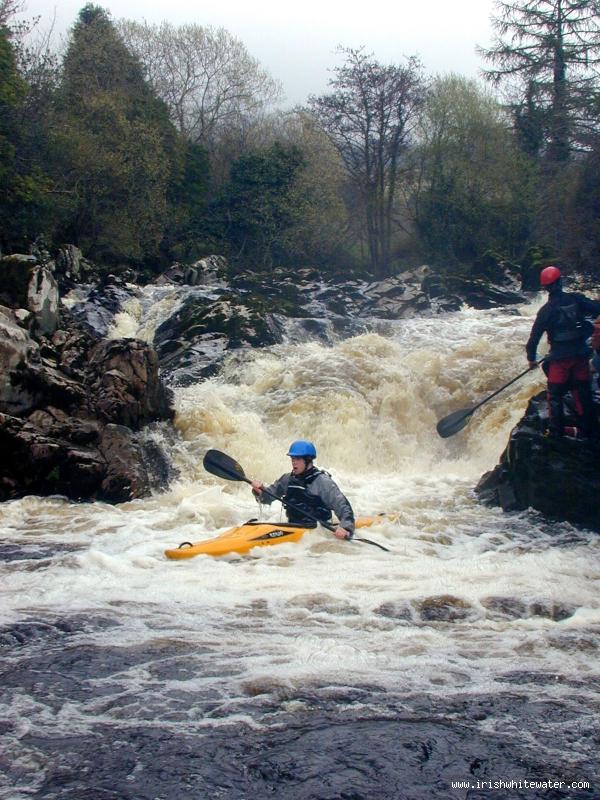
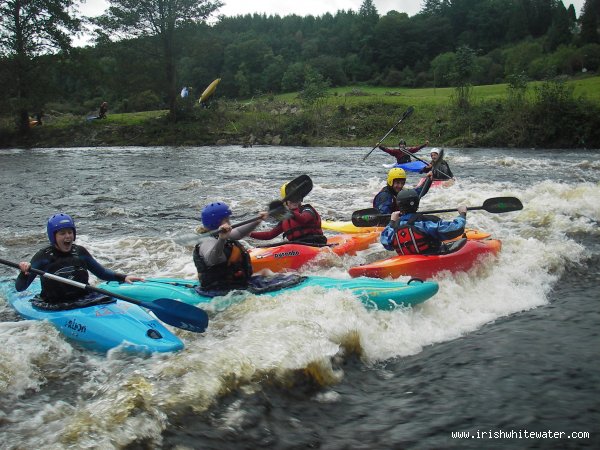
Don't try to teach yourself. Whitewater kayaking involves safety skills — capsize drill, reading water, and rescue techniques — that need to be learned properly from the start.
Beginner courses. There are plenty of providers across Ireland running "Learn to Kayak" weekends that cover the fundamentals: paddling strokes, capsize drill, basic river safety, and your first taste of moving water.
Club membership. Kayak clubs are the backbone of paddling in Ireland. Most clubs run their own beginner courses and pool sessions over the winter months, then take newer members onto easy rivers as they develop. Clubs give you access to equipment, experienced paddlers to learn from, and a group to paddle with — which is essential for safety.
To find a club or provider near you, use the Canoeing Ireland club finder. Canoeing Ireland is the national governing body for the sport and oversees instructor qualifications, safety standards, and the skills award scheme.
On a beginner course or in your first club sessions, you'll learn:
Most people spend their first season building these skills on flat water and easy Grade 1–2 rivers before moving onto anything more challenging.
Progression in whitewater kayaking is about gradually increasing the difficulty of the water you paddle, always with a margin of safety:
There's no rush at all. Some people progress faster, some slower. The important thing is to always paddle within your ability and with people who can support you if needed.
When you're starting out, your club or course provider will supply all the equipment. You don't need to buy anything upfront bar a few personal items.
There's no hurry at all. Most clubs have loan gear for newer members. When you do start buying, have a chat with experienced club members before spending any money. The second-hand market in Ireland is active, and good deals come up regularly on the Canoe and Kayak Sales Ireland Facebook group.
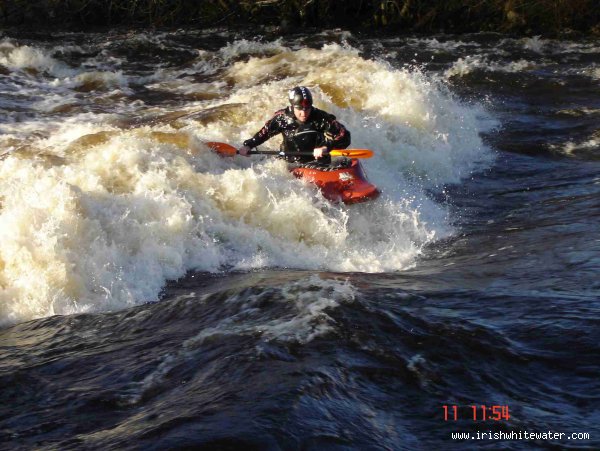
Once you have the basics down, these rivers are great places to build your skills. All are Grade 2, widely paddled, and have well-established access. You can also browse our full list of Grade 1–2 rivers sorted by rating to find more beginner-friendly options near you.
A mighty fun river that holds water well, even into the summer. The section from Stackallen Weir to Slane has a series of weirs and play features, making it a brilliant river for practising skills. Close to Dublin, it's one of the most-paddled training rivers in the country.
An ideal river for beginners, with twelve weirs separated by short flat sections near the town of Adare. Some of the weirs are good for playing in, and the run is short enough to do multiple laps in a session.
A longer, more relaxed paddle through beautiful countryside. The Barrow offers a mix of flat water and the odd weir, making it perfect for building distance paddling skills and confidence before moving onto more technical rivers.
Water levels in Ireland can change fast. A river that was too low yesterday might be perfect after overnight rain, or dangerously high after sustained heavy rainfall. Checking levels before you head out is an essential habit.
Whitewater kayaking carries inherent risk. Taking it seriously from the start is what allows you to enjoy the sport for years to come.
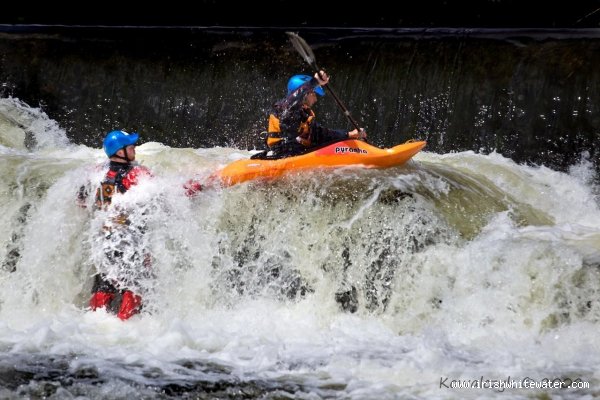
Once you've got the basics and you're comfortable on Grade 2 water, the whole country opens up. Ireland has an extraordinary variety of rivers — from the granite creeks of Wicklow to the limestone gorges of the Burren, the mountain streams of Kerry and Connemara, and the big-volume rivers of the midlands.
Welcome to the community. See you on the river.
